

Sass Jordan was a British-born, Canadian-raised rock singer, songwriter, actress and television personality whose powerful voice and fearless stage presence made her one of the most distinctive female artists in Canadian rock.
Born in Birmingham, England, Jordan was raised primarily in Montreal, Quebec, after her family moved to Canada when she was a young child. Over a career spanning more than four decades, she built a reputation as a passionate rock and blues performer, recording successful albums, touring with some of the biggest names in rock music and becoming a familiar television personality through her role as a judge on Canadian Idol.
Her career was defined by an unmistakable voice, a love of hard-edged rock and soul, and an ability to command a stage. She emerged at a time when female rock singers were still frequently expected to fit into narrow musical categories. Jordan resisted those expectations. She could deliver hard rock with force, but her influences also included soul, rhythm and blues and classic blues. That combination helped make her music difficult to categorize and gave her a distinctive identity.
Her breakthrough came with her 1988 debut album Tell Somebody. The title song introduced Sass Jordan to a national audience and helped establish her as an important new voice in Canadian music. The success of the album led to the Juno Award for Most Promising Female Vocalist in 1989, providing an early indication of the impact she would have on Canadian rock.
Early Life in England and Montreal
Sass Jordan was born Sarah Jordan on December 23, 1960, in Birmingham, England. Her father, Albert Jordan, was a French literature professor, while her mother, Jean Lanceman, had been an English ballerina. When Jordan was three years old, her father accepted a professorship at Concordia University, and the family moved to Montreal. It was there that Jordan would grow up and develop the musical personality that eventually made her famous.
Montreal provided Jordan with a rich cultural environment. As a teenager, she became increasingly interested in rock music and began performing with local bands. She learned guitar and later played bass, gaining experience on the city’s club circuit. Her early years were not spent waiting for a record contract or a major-label opportunity. Instead, she learned the realities of performing by playing live and developing her skills in front of audiences.
One of the important early groups associated with Sass Jordan was the Pinups. Her teenage experiences in Montreal’s music scene helped shape her approach to performing and gave her a grounding in the communal, sometimes unpredictable world of rock clubs.
Jordan also developed an interest in the great vocalists who had come before her. Her musical influences crossed conventional genre boundaries. She admired singers such as Steven Tyler, Paul Rodgers, Robert Palmer and other major male rock vocalists, while also drawing inspiration from powerful soul and R&B performers including Aretha Franklin and Gladys Knight. That mixture would become central to her sound.
Becoming a Professional Musician
Before becoming a solo star, Sass Jordan worked as a session vocalist and songwriter. Her early professional experiences included working with Montreal artists and appearing with the band The Box. She also began establishing herself as a songwriter, with one of her compositions, “Rain,” recorded by Michael Breen and released in 1987. Those experiences were important because Jordan was not simply being presented to the music industry as a singer. She was learning how songs were constructed, how recording sessions worked and how musicians interacted in a professional environment.
In 1986, she recorded as co-lead vocalist on “Come On (Baby Tonight)” with Bündock. By the end of the decade, the groundwork had been laid for a solo career. That opportunity arrived when Atlantic Records signed Jordan.
Sass Jordan’s debut album, Tell Somebody, was released in 1988. The title track quickly became her breakthrough song in Canada. The single reached No. 11 on the Canadian chart and its video received heavy exposure on MuchMusic, Canada’s influential music television network. Jordan later recalled the astonishing speed with which she went from relative obscurity to being recognized by audiences across the country.
Tell Somebody and the Juno Award
The success of Tell Somebody transformed Sass Jordan‘s career. The album demonstrated that there was an audience for a female rock performer who could combine the toughness of hard rock with the emotional depth of blues and soul.
The title track became the key to her breakthrough, but the album also produced other Canadian successes, including “Double Trouble,” “Stranger Than Paradise” and “So Hard.” Jordan’s distinctive appearance, energetic performances and powerful voice made her a natural fit for music television, while her live performances helped establish her credibility as a rock artist.
In 1989, she received the Juno Award for Most Promising Female Vocalist of the Year. The award confirmed that Jordan was more than a promising club performer. She had become one of Canada’s leading new female musical talents. She would later receive further Juno nominations for Best Female Vocalist in 1990, 1993 and 1995.
Her rapid rise also encouraged her to look beyond Canada. In January 1990, Jordan relocated to Los Angeles in an attempt to expand her career in the United States. It was a significant move for an artist who had already achieved considerable success at home.
Racine and Her Greatest Commercial Success
Sass Jordan’s defining album arrived in 1992. Racine, released by MCA Records, became the most successful album of her career. Recorded in Los Angeles, it contained several songs that became important parts of her catalogue, including “Make You a Believer,” “I Want to Believe,” “You Don’t Have to Remind Me” and “Goin’ Back Again.” The album ultimately sold an estimated 450,000 copies worldwide, with approximately 100,000 copies sold in Canada.
“Make You a Believer” and “I Want to Believe” both appeared on Billboard’s Mainstream Rock chart, giving Jordan increased visibility in the American rock market.
The success of Racine led to one of the most significant recognitions of her career. Billboard named Jordan its Top Female Rock Artist of 1992. For a Canadian artist attempting to establish herself in the United States, the honour was a major achievement.
Racine also helped cement Jordan’s reputation as a performer capable of standing alongside some of the biggest rock acts of the period. She toured with major artists including Aerosmith, The Rolling Stones, AC/DC and Van Halen. Her ability to hold her own on large stages demonstrated that her success was not dependent solely on recording or music television. She was, above all, a live performer.
Working With Joe Cocker and The Bodyguard
Sass Jordan’s growing reputation also led to an unexpected Hollywood connection.
In 1992, she recorded “Trust in Me,” a duet with legendary British singer Joe Cocker, for the soundtrack of the film The Bodyguard. The opportunity reportedly came after actor Kevin Costner heard Jordan’s music and became aware of her work.
The soundtrack became one of the biggest-selling soundtrack albums in music history. Although Jordan’s contribution represented only one part of the project, working with Cocker placed her alongside another iconic rock and soul vocalist and gave her another connection to a huge international audience.
The collaboration also reflected something important about Jordan’s artistic identity. She was never simply a conventional rock singer. Her voice could move naturally between rock, blues, soul and roots music, making a collaboration with someone like Cocker particularly appropriate.
Rats and Continuing Her Career
Sass Jordan followed Racine with Rats in 1994. Although the album did not reproduce the commercial success of its predecessor, it contained “Sun’s Gonna Rise,” which became Jordan’s first appearance on the Billboard Hot 100.
Jordan later regarded Rats as one of her favourite albums, even though its commercial performance did not match expectations. Her subsequent relationship with the major-label system became more complicated. After leaving MCA, she recorded for Aquarius Records and released albums including Present in 1997 and Hot Gossip in 2000. These albums reflected an artist continuing to evolve rather than attempting simply to recreate the sound of Racine. Jordan’s career would repeatedly move between rock, blues, roots music and more mainstream material.
Acting and Love, Janis
Sass Jordan also demonstrated her versatility as a performer outside traditional rock concerts.
In 2001, she took on the role of Janis Joplin in the musical Love, Janis. The part was a natural fit for a singer whose own style had been influenced by blues and powerful rock vocalists. Performing Joplin’s material required not only vocal ability but also an understanding of the emotional intensity associated with one of rock’s most famous performers. Jordan’s involvement in the production further demonstrated that she was comfortable crossing between music, theatre and television.
Canadian Idol
A new generation came to know Sass Jordan through television. In 2003, she became one of the judges on Canadian Idol, remaining with the programme for all six seasons. Her role gave her a national platform outside the traditional music industry and introduced her personality to viewers who may not have followed her recording career.
Sass Jordan was known for being candid and expressive as a judge. She brought the perspective of someone who had spent decades performing professionally, recording albums and touring with major rock acts.
Her television work also reinforced another aspect of her legacy, her mentorship. She had experienced the uncertainty of beginning a career herself, and her position on Canadian Idol allowed her to offer advice and criticism to aspiring performers. For many viewers, she became as recognisable for her personality and honesty as for her music.
A Return to Blues and Rock
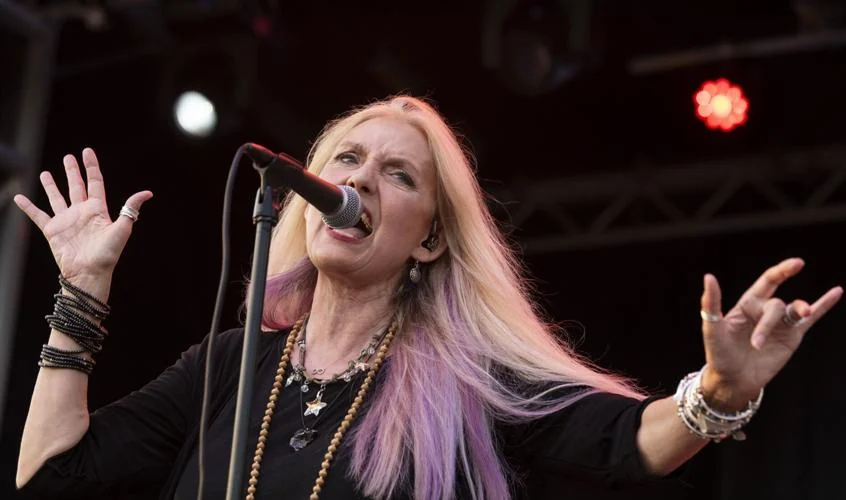
Sass Jordan continued recording and performing long after the height of her commercial success. Her later work increasingly reflected her affection for blues.
Albums such as Rebel Moon Blues, released in 2020, and Bitches Blues, released in 2022, showed an artist reconnecting strongly with the blues influences that had always been present in her music. Rebel Moon Blues reached the top five of the U.S. blues chart, demonstrating that Jordan continued to attract an audience decades after her initial breakthrough. Her catalogue from this period also illustrated the breadth of her career. She was not attempting to remain frozen in the sound of the early 1990s. Instead, she continued exploring the musical styles that had inspired her throughout her life.
Sass Jordan also remained connected to hard rock. In 2012, she became part of the project S.U.N., working with musicians including Brian Tichy, Michael Devin and Tommy Stewart. Her musical interests continued to move between heavy rock and blues.
Her Final Years
Even after more than four decades in music, Sass Jordan remained active as a performer.
In September 2026, she cancelled remaining tour dates because of a serious medical condition.
Sass Jordan died on October 2, 2026. Her family later announced that she had died peacefully surrounded by those who loved her. aged 65.
Her family described her as an “inimitable force of nature” and an “irreplaceable being of light and joy,” sentiments that captured the personality many colleagues and fans associated with her. Her death prompted tributes from musicians and others who had worked with her throughout her career.
The Legacy of Sass Jordan
Sass Jordan’s legacy cannot be reduced to a single song or album.
For Canadian rock, she represented persistence, individuality and musical independence. She achieved national recognition with Tell Somebody, reached her commercial peak with Racine, earned international attention through The Bodyguard soundtrack and major tours, and remained visible to Canadian audiences through Canadian Idol.
Her achievements were particularly significant because she established herself in a rock industry that had traditionally been dominated by men. She did not need to soften her voice or personality to fit into that environment. Her raspy, powerful vocals became one of her trademarks, while her energetic performances established her as a genuine rock frontwoman.
Her influence also extended to musicians who passed through her bands. One of the most notable was Taylor Hawkins, who later became famous as the drummer of Foo Fighters. Hawkins had toured with Jordan early in his career, and she was an important part of his formative experience as a professional musician. Years later, Dave Grohl publicly acknowledged Jordan’s influence on Hawkins.
That story illustrates an important part of Jordan’s contribution. Her career was not only about records she sold or awards she won. She helped create opportunities and experiences for other musicians.
Sass Jordan also demonstrated the value of longevity. Her career moved through changing musical fashions, record-company relationships, television, theatre and the revival of interest in blues. Rather than disappearing after her commercial peak, she continued to record, tour and experiment.
Her journey from a young musician in Montreal to an internationally recognised rock singer was remarkable. She became a Juno Award winner, a Billboard-recognised artist, a soundtrack performer, a touring rock star, an actress and a television judge.
Check out Sass Jordan on Amazon by clicking here.
If you found this interesting please share it with your friends and family, and check out some of our other articles on Musicians who Died in 2026.
.
