
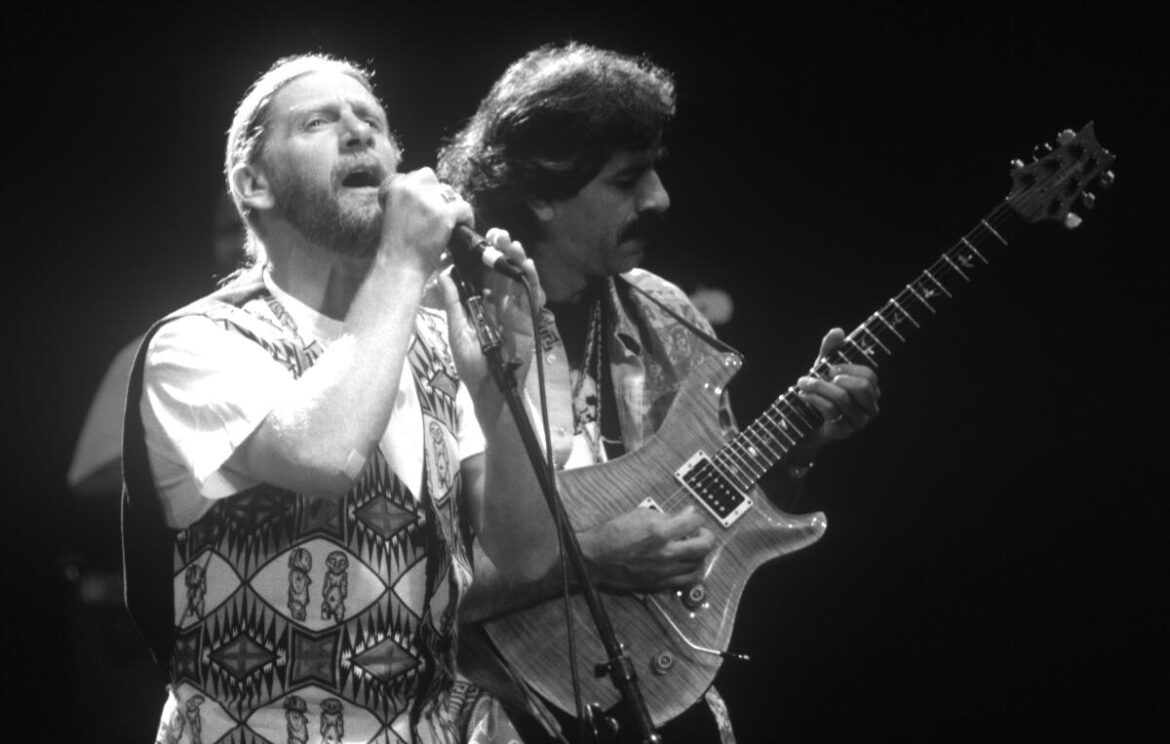
Alex Ligertwood was best known as a lead vocalist for Santana, with five different stints from 1979 to 1994, which included the US Festival in 1982 and Live Aid in 1985. He was credited as lead vocalist on Santana songs such as “All I Ever Wanted,” “You Know That I Love You,” “Winning” and “Hold On.”
He also had co-writing credits for Santana songs including “Brightest Star,” “E Papa Re,” “Make Somebody Happy,” “Somewhere in Heaven” and “The Nile.”
Alex Ligertwood was born Alexander John Ligertwood was born on December 18, 1946, in Glasgow. and grew up in the Drumchapel district, an area known in the mid 20th century for its strong working class identity and vibrant grassroots music culture. From the beginning, Ligertwood’s life was shaped by sound. His father, though not a professional musician, played drums recreationally, and that early exposure to rhythm left a lasting impression. Music in the household was not formalized or academic, but it was constant, instinctive, and expressive, qualities that would define Ligertwood’s own approach.
As a child, he participated in school choirs and local music activities, including performing with a Boys’ Brigade pipe band. These early experiences gave him a grounding in timing, discipline, and ensemble performance. However, Ligertwood was largely self taught. He did not follow the traditional conservatory route, instead learning by ear, imitation, and experimentation. Like many young musicians in Britain during the 1950s and early 1960s, he was swept up in the skiffle movement, a do it yourself musical culture that encouraged teenagers to pick up guitars and perform.
Alex Ligertwood early influences came heavily from American soul and rhythm and blues. Artists such as Otis Redding, Sam Cooke, Marvin Gaye, and Ray Charles shaped his vocal sensibilities. From them, he absorbed phrasing, emotional delivery, and a deep sense of groove. Unlike many British rock singers of his generation who leaned heavily into blues rock stylings, Ligertwood developed a more fluid, soul oriented voice, capable of both power and nuance.
Early Musical Development and First Bands
Alex Ligertwood’s professional journey began in the 1960s with a series of local bands. Among his earliest groups were The Meridians and The Kwintones, outfits that allowed him to perform regularly and develop his stage presence. These bands did not achieve major commercial success, but they were essential training grounds. He learned how to engage audiences, adapt to different venues, and refine his vocal control.
A significant step forward came when he joined The Senate, a seven piece soul ensemble that toured extensively across Europe. This experience marked his transition from local performer to working professional musician. Touring exposed him to diverse audiences and musical expectations, and it demanded consistency and stamina. Performing night after night strengthened his voice and sharpened his instincts.
During this period, Alex Ligertwood also began to establish a reputation among fellow musicians as a reliable and highly adaptable vocalist. He was not limited to one genre. He could move between soul, rock, funk, and jazz influenced material with relative ease. This versatility would become one of his defining traits and a key reason why he was sought after by prominent artists.
Collaborations and Expanding Horizons in the 1970s
The 1970s were a decade of expansion for Alex Ligertwood. He collaborated with a range of influential musicians, gaining exposure to new styles and audiences. One of the most notable associations was with Jeff Beck. Working with Beck placed Ligertwood within a circle of elite rock and fusion musicians, where technical excellence and innovation were expected.
He also performed with Brian Auger’s Oblivion Express, a group known for blending jazz, rock, and funk into a sophisticated, groove driven sound. This environment was particularly well suited to Ligertwood’s abilities. His soulful voice complemented the band’s complex arrangements, and he demonstrated an ability to navigate intricate musical structures without losing emotional immediacy.
Additionally, he worked with Elton John and other prominent figures in the music industry, often contributing backing vocals or participating in collaborative projects. These experiences broadened his professional network and reinforced his reputation as a “musician’s singer,” someone respected within the industry even if not always widely recognized by the general public.
Santana and International Recognition
Alex Ligertwood’s most significant and enduring contribution to music came through his association with Santana, led by Carlos Santana. He first joined the band in 1979, at a time when Santana was evolving its sound. The group, originally known for instrumental Latin rock and extended improvisations, began incorporating more structured songs with prominent vocals.
Ligertwood’s arrival was crucial to this transition. His voice brought a new dimension to the band’s music, combining rock power with soul sensitivity. He was not merely a frontman, but an integral part of the band’s identity during this era.
He contributed to several albums and became the lead vocalist on a number of successful tracks. Among the most notable were “Winning,” “Hold On,” “You Know That I Love You,” and “All I Ever Wanted.” These songs achieved commercial success and received significant radio airplay, helping Santana reach a broader audience in the late 1970s and 1980s.
“Winning,” in particular, showcased Ligertwood’s vocal strengths. The song required both restraint and intensity, building gradually to an emotional climax. His performance captured the sense of determination and uplift that defined the track, making it one of Santana’s most memorable songs of that period.
.
Alex Ligertwood’s tenure with Santana was not continuous. He joined and left the band multiple times between 1979 and 1994, reflecting both the evolving nature of the group and the broader dynamics of the music industry. Nevertheless, his contributions during these years were substantial and enduring.
Live Performance and Stage Presence
One of Alex Ligertwood’s greatest strengths was his ability as a live performer. He possessed a vocal range of nearly four octaves, allowing him to handle a wide variety of material. More importantly, he understood how to use that range effectively. He could deliver powerful high notes when needed, but he also knew when to hold back, using subtlety to create emotional impact.
His stage presence was confident but not flamboyant. Unlike some rock frontmen who relied on theatrical gestures, Ligertwood focused on the music itself. His performances were characterized by sincerity and intensity rather than spectacle.
A defining moment in his live career came during Live Aid, where he performed with Santana. The event, watched by millions around the world, provided a platform for artists to demonstrate their abilities on an unprecedented scale. Ligertwood rose to the occasion, delivering a performance that reinforced his reputation as a world class vocalist.
Musical Style and Philosophy
Alex Ligertwood’s style was rooted in soul, but it was not confined by it. He approached each song individually, adapting his tone, phrasing, and delivery to suit the material. This flexibility allowed him to move seamlessly between genres.
He often emphasized the importance of emotional honesty in performance. For Ligertwood, singing was not about technical display alone, but about conveying feeling. This philosophy aligned him with the great soul singers who had influenced him, and it set him apart from more purely technical vocalists.
His voice combined clarity with grit. It could be smooth and melodic, or raw and powerful, depending on the context. This duality made him particularly effective in Santana’s music, which often blended contrasting elements such as Latin rhythms, rock guitar, and spiritual themes.
Later Career and Continued Work
After his primary years with Santana, Alex Ligertwood remained active in music. He participated in various touring projects, including World Classic Rockers, where he performed alongside other veteran musicians. These projects allowed him to revisit classic material while continuing to engage with audiences around the world.
In 2019, he released a solo album titled Outside the Box. The album reflected both his experience and his willingness to experiment. It included new material as well as reinterpretations of earlier songs, demonstrating that his creative instincts remained strong even in his seventies.
He continued to tour internationally, particularly in Europe and Japan, where he maintained a loyal fan base. His performances during this period were marked by consistency and professionalism. Even as his voice aged, he retained much of its character and expressive power.
Personal Life and Character
Despite his achievements, Alex Ligertwood remained relatively private. He was known among colleagues as approachable, dedicated, and deeply committed to his craft. He did not cultivate a larger than life public persona, preferring to let his music speak for itself.
Fellow musicians often spoke of his reliability and generosity. He was seen as someone who contributed positively to group dynamics, an important quality in collaborative environments such as touring bands.

.
Final Years and Passing
Alex Ligertwood remained active almost until the end of his life. His final performances took place in April 2026, only weeks before his death. He died on April 30, 2026, at his home in Santa Monica, at the age of 79.
Legacy and Influence
Alex Ligertwood’s legacy is defined by his voice and his versatility. While he may not have achieved the same level of mainstream celebrity as some of his contemporaries, his impact within the music community is significant.
His work with Santana represents a crucial chapter in the band’s history, helping to shape its sound during a period of transition and commercial success. The songs he performed continue to be played and appreciated decades later.
Beyond Santana, Alex Ligertwood’s collaborations with artists like Jeff Beck and Brian Auger demonstrate the breadth of his abilities. He was equally comfortable in rock, soul, and jazz influenced settings, a rare quality that earned him respect across genres.
Ligertwood’s career also serves as an example of longevity in music. Spanning more than sixty years, it reflects sustained commitment and adaptability. He navigated changes in the industry, shifts in musical trends, and the challenges of aging as a performer, all while maintaining his artistic identity.
Conclusion
Alexander John Ligertwood’s life was devoted to music in its many forms. From his beginnings in Glasgow to international stages, he pursued his craft with consistency and passion. His voice, shaped by soul and refined through decades of performance, became his signature.
He leaves behind a body of work that continues to resonate, particularly through his recordings with Santana and his numerous collaborations. For listeners and musicians alike, Ligertwood stands as a reminder that true artistry lies not only in fame, but in dedication, versatility, and the ability to connect through sound.
Check out Alex Ligertwood on Amazon by clicking here.
Check out Santana on Amazon by clicking here.
If you found this interesting please share it with your friends and family, and check out some of our other articles on Musicians who Died in 2026.
.
