
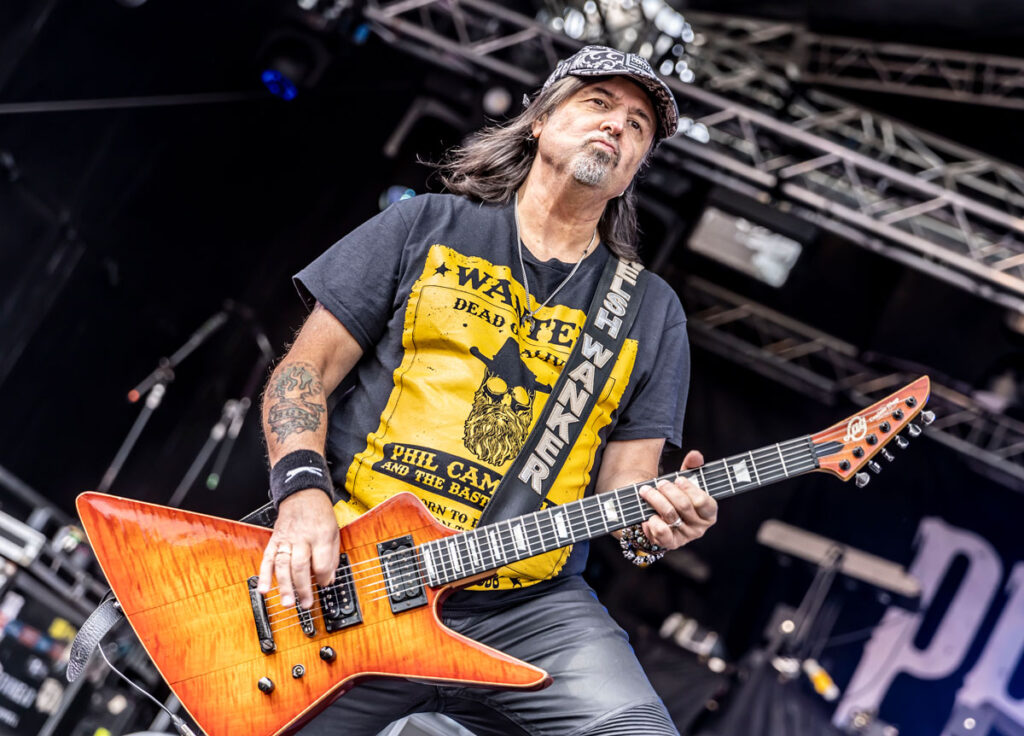
Phil Campbell was born Philip Anthony Campbell on May 7, 1961 in Pontypridd, Wales and was one of the most enduring and recognizable guitarists in heavy rock. For more than three decades he served as the lead guitarist of the legendary British band Motörhead, playing alongside founder and frontman Lemmy Kilmister.
His tenure with the group lasted from 1984 until the band’s dissolution in 2015, after Lemmy’s death brought Motörhead to an end. Campbell later formed the family-centered rock group Phil Campbell and the Bastard Sons with three of his sons, continuing to perform and record music well into the 2020s.
Campbell died on March 13, 2026 at the age of 64, reportedly after complications following a major operation, prompting tributes from across the rock and metal world.
The story of Phil Campbell is closely tied to the evolution of heavy rock and metal from the late twentieth century onward. His career spanned underground metal scenes, global arena tours, and family-driven musical collaborations. Through his work with Motörhead and his later projects, Campbell helped shape the aggressive yet melodic guitar sound that defined a generation of hard rock.
Early Life and Musical Influences
Phil Campbell was born in Pontypridd, South Wales, a region with a long tradition of working-class culture and musical creativity. Growing up in the 1960s and 1970s, he was exposed to the rapidly expanding world of rock music, which would profoundly shape his life. Campbell began playing guitar at the age of ten, discovering a passion that would quickly turn into a lifelong commitment. (Wikipedia)
Like many aspiring guitarists of his era, Campbell was inspired by the pioneers of electric guitar. Among the artists who influenced his playing were Jimi Hendrix, Jimmy Page, Tony Iommi, Jan Akkerman, Michael Schenker, and Todd Rundgren.
These musicians represented a spectrum of guitar styles, from blues-inspired improvisation to heavy metal riffing and progressive rock experimentation. Campbell absorbed elements from each of them. Hendrix’s expressive phrasing, Iommi’s heavy riff structures, and Page’s dynamic songwriting all left traces in Campbell’s playing style.
As a teenager, Campbell immersed himself in the Welsh and British rock scenes. He practiced constantly and began performing in local bands, developing both his technical skills and stage presence. By the late 1970s he had already decided that music would be his career.
Early Career and Persian Risk
Campbell’s first major professional breakthrough came when he joined the Welsh heavy metal band Persian Risk in the early 1980s. The group was part of the New Wave of British Heavy Metal (NWOBHM) movement, a cultural wave that also produced bands such as Iron Maiden and Saxon.
With Persian Risk, Campbell recorded several singles and appeared on compilation albums that circulated widely among metal fans. Notable releases included the 1981 single “Calling for You” and contributions to heavy metal compilation records in the early 1980s.
Although Persian Risk never achieved massive mainstream success, the band provided Campbell with invaluable experience. Touring, recording, and performing in the vibrant NWOBHM scene allowed him to refine his guitar style. The group also helped him build connections within the British rock industry.
This period of Campbell’s career laid the groundwork for his future success. His reputation as a skilled guitarist with a powerful live presence began to grow. It would not be long before an opportunity arose that would change his life.
Joining Motörhead
In 1984, Phil Campbell auditioned for Motörhead, the hard-driving rock band led by Lemmy Kilmister. At the time, the group was searching for a guitarist to join their lineup after several personnel changes. Campbell’s audition impressed Lemmy, and he was invited to join the band.
Motörhead’s music combined elements of heavy metal, punk, and classic rock, producing a loud, fast, and aggressive sound that influenced countless bands. By joining the group, Campbell stepped into one of the most intense and demanding touring environments in rock music.
His first album with the band was “Orgasmatron” (1986), which helped re-energize Motörhead during a transitional period. Over the next three decades Campbell would remain a core member of the group, playing on numerous albums and participating in relentless global touring.
Motörhead’s lineup during much of Campbell’s tenure included Lemmy on bass and vocals and Mikkey Dee on drums. This trio became one of the band’s most stable and successful lineups.
The Motörhead Years (1984–2015)
Phil Campbell’s time in Motörhead spanned over thirty years, making him one of the longest-serving members in the band’s history. During this period the group released a series of albums that reinforced their reputation as one of rock’s loudest and most uncompromising acts.
.
Among the albums Campbell played on were:
- Orgasmatron (1986)
- Rock ’n’ Roll (1987)
- 1916 (1991)
- March ör Die (1992)
- Bastards (1993)
- Sacrifice (1995)
- Overnight Sensation (1996)
- Snake Bite Love (1998)
- We Are Motörhead (2000)
- Hammered (2002)
- Inferno (2004)
- Kiss of Death (2006)
- Motörizer (2008)
- The Wörld Is Yours (2010)
- Aftershock (2013)
- Bad Magic (2015)
Throughout these years Campbell’s guitar work helped shape Motörhead’s distinctive sound. His riffs were heavy yet melodic, and his solos blended blues phrasing with high-speed metal technique.
On stage, Campbell developed a reputation for energetic performances and humorous stage banter. His personality balanced Lemmy’s iconic presence, contributing to the band’s chemistry.
Motörhead toured almost constantly, playing thousands of shows worldwide. The band’s live performances were legendary for their volume and intensity, earning them a fiercely loyal fan base.
The End of Motörhead
Motörhead’s long run came to an end in December 2015, when Lemmy Kilmister died after a brief battle with cancer. His death effectively ended the band, as the remaining members agreed that Motörhead could not exist without him.
For Campbell, the loss was deeply personal. After more than thirty years together, Lemmy had been both a bandmate and a close friend. The end of Motörhead marked the conclusion of one of the longest partnerships in rock music.
Yet Campbell did not retire. Instead, he quickly began planning a new musical chapter.
Phil Campbell and the Bastard Sons
Following the dissolution of Motörhead, Campbell formed Phil Campbell and the Bastard Sons, a band that featured three of his sons: Todd Campbell, Tyla Campbell, and Dane Campbell.
The group initially emerged from a side project known as Phil Campbell’s All Starr Band, but it soon evolved into a full-time touring act. The lineup also included vocalist Neil Starr, later replaced by Joel Peters.
The band’s debut EP was released in 2016, followed by their first full-length album “The Age of Absurdity” (2018). The album received positive reviews and won recognition within the metal community.
Subsequent releases included:
- We’re the Bastards (2020)
- Live in the North (2023)
- Kings of the Asylum (2023)
The group toured extensively across Europe and beyond, performing both their own material and classic Motörhead songs. Their concerts combined family chemistry with the raw energy of traditional heavy metal.
For Campbell, playing alongside his sons represented a deeply personal achievement. Music became a shared family enterprise, and audiences often responded warmly to the generational collaboration.
Solo Work and Collaborations
In addition to his band projects, Campbell also pursued solo work. His 2019 album “Old Lions Still Roar” featured numerous guest musicians and showcased his versatility as a guitarist.
He also appeared as a guest musician on various recordings, collaborating with artists from across the rock and metal spectrum. These projects demonstrated Campbell’s willingness to explore different styles while maintaining his signature sound.
Guitar Style and Legacy
Phil Campbell’s playing style combined several elements that defined classic heavy rock guitar:
- Powerful riffing influenced by early heavy metal
- Blues-based soloing techniques
- High-energy rhythm playing suited to Motörhead’s fast tempo
Unlike some guitarists who focused primarily on technical virtuosity, Campbell emphasized groove, tone, and raw power. His riffs often served as the backbone of Motörhead’s songs.
Many guitarists cite Campbell as an influence, particularly within the metal and hard rock communities. His work demonstrated how classic rock roots could be fused with aggressive modern metal energy.
Personal Life
Outside of music, Phil Campbell was known as a devoted family man. His family often described him as a loving husband, father, and grandfather. In tributes following his death, relatives said he was affectionately known as “Bampi” to his grandchildren.
Despite decades of touring and international fame, Campbell remained closely connected to his Welsh roots. He spent much of his life living near Pontypridd, the town where he was born.
Death and Tributes
Phil Campbell died on March 13, 2026 at the age of 64 after complications following a major operation.
News of his death prompted widespread tributes from musicians and fans around the world. His family described him as a “devoted husband, a wonderful father, and a proud grandfather,” and asked for privacy while mourning their loss. (Kerrang!)
Campbell’s death marked the loss of one of the last surviving core members of Motörhead’s classic era. Many musicians credited him with helping define the sound of heavy rock during the late twentieth century.
Historical Significance
Phil Campbell’s importance in rock history lies not only in his technical ability but also in his longevity. Few guitarists remained in a major band for as long as he did, and even fewer continued performing actively decades after achieving fame.
His career reflects the evolution of heavy metal from underground subculture to global phenomenon. By maintaining the raw, uncompromising spirit of Motörhead while also embracing new collaborations, Campbell bridged multiple generations of rock music.
Conclusion
Phil Campbell’s life was a testament to dedication, resilience, and the enduring power of rock and roll. From his beginnings as a young guitarist in South Wales to his decades on international stages with Motörhead, he built a career defined by passion and authenticity.
Even after the end of Motörhead, Campbell refused to slow down. Instead, he reinvented himself through Phil Campbell and the Bastard Sons, proving that music remained central to his life.
His death in 2026 closed the chapter on a remarkable career, but his influence continues through the recordings, performances, and musicians he inspired. For fans of heavy rock, Phil Campbell will always be remembered as one of the guitarists who kept the spirit of Motörhead alive long after the amplifiers stopped roaring.
Check out Phil Campbell on Amazon by clicking here.
Check out Motörhead on Amazon by clicking here.
If you found this interesting please share it with your friends and family, and check out some of our other articles on Musicians who Died in 2026.
.
