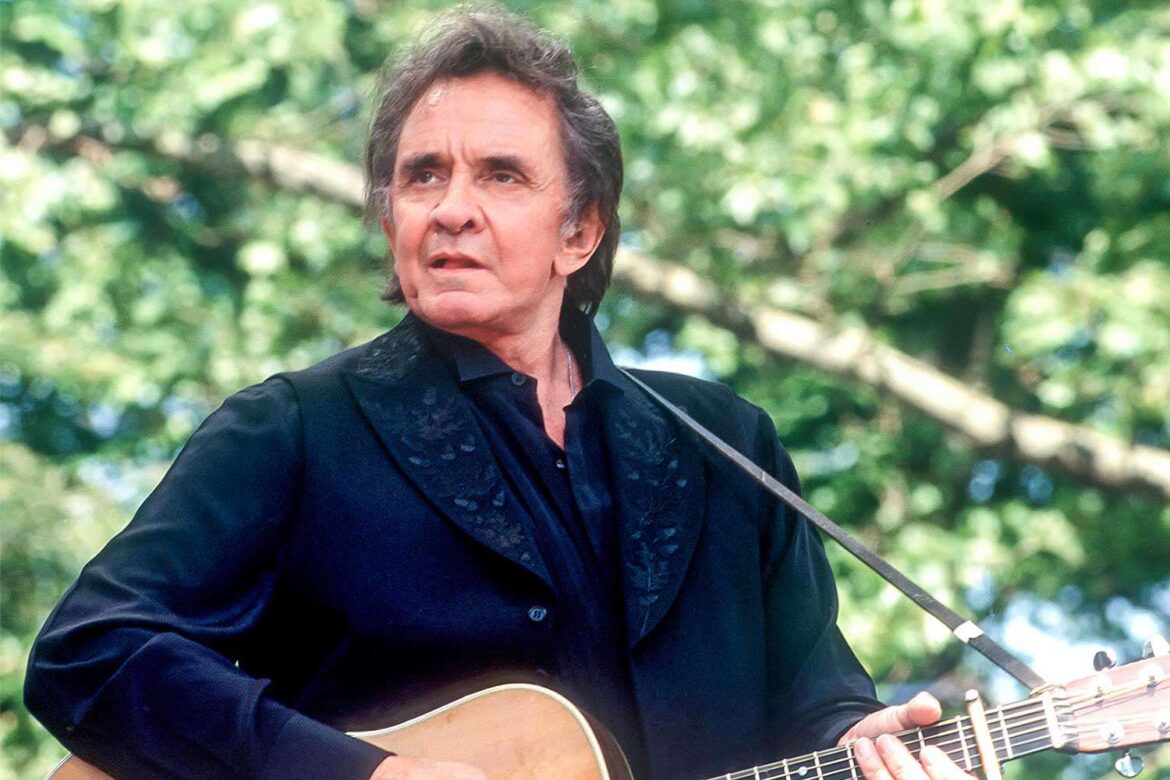
Johnny Cash was one of the most influential and enduring figures in American music. More than just a singer-songwriter, Cash became a cultural symbol, an artist who gave voice to the broken, the restless, and the morally conflicted.
His music is deeply rooted in sorrow, moral tribulation, and redemption, themes that grew stronger and more profound in the later stages of his career. With his deep, calm bass-baritone voice, the chugging, train-like rhythms of his band the Tennessee Three, and his stark, all-black wardrobe, Cash cultivated a persona that was rebellious, somber, and humble all at once. Known worldwide as the “The Man in Black,” Johnny Cash used his art to confront pain, injustice, and the human need for forgiveness.
Early Life and Influences
Johnny Cash was born J. R. Cash on February 26, 1932 in Kingsland, Arkansas, and raised in Dyess, a small farming community created as part of a New Deal resettlement program. His childhood was shaped by hardship. His family worked the cotton fields, and Cash learned early what physical labor, poverty, and perseverance meant. Tragedy struck when his older brother Jack died in a sawmill accident when Johnny was only twelve years old. Jack’s death haunted him for the rest of his life, and many biographers argue that it fueled Cash’s lifelong preoccupation with mortality, guilt, and spiritual struggle.
Growing up in a deeply religious household, Cash was immersed in gospel music from an early age. He sang hymns with his family and learned how music could express both sorrow and hope. At the same time, he absorbed folk songs, work songs, and country ballads, forming a musical identity rooted in American tradition. These early influences of faith, loss, labor, and storytelling became the foundation of his songwriting voice.
The Birth of a Sound
After serving in the U.S. Air Force in the early 1950s, Cash moved to Memphis, Tennessee, where he began pursuing a career in music. He auditioned for Sun Records, the legendary label that also launched Elvis Presley, Jerry Lee Lewis, and Carl Perkins. Unlike Elvis’s rock-and-roll swagger or Lewis’s wild piano style, Cash brought something darker and more restrained. His early songs like “Cry! Cry! Cry!” and “Folsom Prison Blues” established his signature sound: a steady, train-like rhythm driven by Luther Perkins’s guitar and Marshall Grant’s bass. This minimalistic, chugging beat became known as the “boom-chicka-boom” sound of the Tennessee Three.
Cash’s voice was immediately recognizable. His bass-baritone delivery was calm and controlled, yet emotionally loaded. He did not need to shout to command attention; his power came from understatement. The way he sang suggested someone who had lived through hardship and come out the other side still standing—but scarred.
Themes of Sorrow and Moral Tribulation
From the beginning, Cash’s music dealt with people on the margins: prisoners, drifters, addicts, and sinners. “Folsom Prison Blues,” one of his earliest hits, is sung from the perspective of a man serving time for murder. Instead of glamorizing crime, Cash humanized the criminal, focusing on regret and confinement. Lines like “I know I had it coming / I know I can’t be free” reveal an acceptance of responsibility that became central to Cash’s moral worldview.
.
Cash often explored moral conflict rather than simple good versus evil. His characters wrestle with temptation, guilt, and faith. In songs like “I Walk the Line,” he sings about fidelity and discipline, promising to stay true despite inner struggles. The song reflects Cash’s own life: a man deeply aware of his weaknesses but striving for moral order.
Rebellion and the Man in Black
Johnny Cash’s rebelliousness was not loud or flashy, it was quiet and defiant. He did not rebel by destroying traditions but by exposing their contradictions. His choice to wear all black onstage became a visual symbol of this stance. In his own words, he wore black for the poor, the beaten-down, the forgotten, and the imprisoned. His song “Man in Black” explains the symbolism directly: Cash dressed in black to remind the world of injustice and suffering.
This somber wardrobe, paired with his serious demeanor, created a powerful image. While other performers dazzled with glitter and smiles, Cash stood still, dressed like a preacher or an outlaw, delivering songs about death, sin, and salvation. He became a bridge between sacred and secular music, blending gospel’s moral urgency with country’s storytelling grit.
Prison Concerts and Empathy
One of the most defining aspects of Cash’s career was his commitment to performing for prisoners. His live albums At Folsom Prison (1968) and At San Quentin (1969) are among the most famous recordings in music history. These concerts were not publicity stunts, they were deeply personal to Cash. He felt a strong connection to inmates, seeing them not as monsters but as flawed human beings capable of change.
At Folsom Prison, Cash opened with “Folsom Prison Blues,” and the reaction from the inmates was electric. His presence validated their existence. He sang to them, not at them. The album captured not only music but a moment of shared humanity between artist and audience. Cash used his fame to advocate for prison reform, speaking publicly about the need for compassion and rehabilitation rather than simple punishment.
Personal Struggles and Redemption
Johnny Cash’s life was marked by inner conflict. Despite his public image as a moral voice, he struggled privately with drug addiction, especially to amphetamines and barbiturates. These addictions nearly destroyed his career and his relationships. His first marriage ended in divorce, and he faced repeated arrests and professional setbacks.
Yet redemption became more than just a theme in his music, it became his lived experience. His relationship with June Carter, whom he later married, played a central role in his recovery. June was both his partner and his anchor, encouraging him to confront his demons and return to his faith. Their love story, filled with tenderness and perseverance, stands as one of the most celebrated partnerships in music history.
Cash’s renewed commitment to Christianity deepened the spiritual dimension of his later work. He recorded gospel albums and spoke openly about grace, forgiveness, and humility. His life became a testament to the idea that failure does not have to be final.
The Later Years and Artistic Reinvention
In the 1990s, when many assumed Johnny Cash was a relic of the past, he experienced a powerful artistic rebirth. Collaborating with producer Rick Rubin, Cash recorded a series of stripped-down albums under the American Recordings label. These recordings featured just Cash and his guitar, or with minimal accompaniment, and focused on raw emotion.
In this final stage of his career, Cash’s themes of sorrow and redemption reached their deepest expression. Songs like “Hurt,” originally by Nine Inch Nails, became haunting meditations on regret and mortality. When Cash sang “Everyone I know goes away in the end,” it felt like a man looking directly at death, unafraid but deeply reflective.
The video for “Hurt,” showing an aging Cash in his home, surrounded by memories and decay, became one of the most powerful visual statements in music history. It reframed his entire career as a long confession—honest, painful, and ultimately dignified.
.
Legacy
Johnny Cash died in 2003, but his influence has only grown stronger. He is remembered not just as a country singer, but as an American voice, someone who captured the contradictions of the nation itself. His music spoke to working people, prisoners, believers, skeptics, rebels, and the broken-hearted alike.
Cash’s legacy lies in his refusal to simplify the human experience. He sang about sin, but also about grace. He acknowledged darkness, but never denied the possibility of light. His deep, calm voice carried authority not because it demanded respect, but because it earned it through honesty.
The Man in Black remains a symbol of moral courage and emotional truth. In a world that often avoids discomfort, Johnny Cash leaned into it. He made sorrow sound beautiful, tribulation meaningful, and redemption possible.
Conclusion
Johnny Cash was far more than a performer. He was a storyteller, a witness, and a moral voice. Born into hardship, shaped by loss, and tested by addiction, Cash turned his struggles into art that continues to resonate across generations. His bass-baritone voice, the chugging rhythms of the Tennessee Three, his black-clad figure, and his prison concerts all combined to create a legacy rooted in empathy and truth.
In the end, Johnny Cash did not just sing about redemption, he lived it. And that is why his music still matters.
Check out Johnny Cash on Amazon by clicking here.
If you found this interesting please share it with your friends and family, and check out some of our other articles on Dead Musicians.
.

So Sad. A true Musical Legend!
Pingback: Songwriter Jim McBride died January 7, 2026 - Dead Musicians
Pingback: Kris Kristofferson died September 28, 2024. - Dead Musicians
Pingback: The Killer Jerry Lee Lewis died October 28, 2022 - Dead Musicians
Pingback: Don Williams dies aged 78